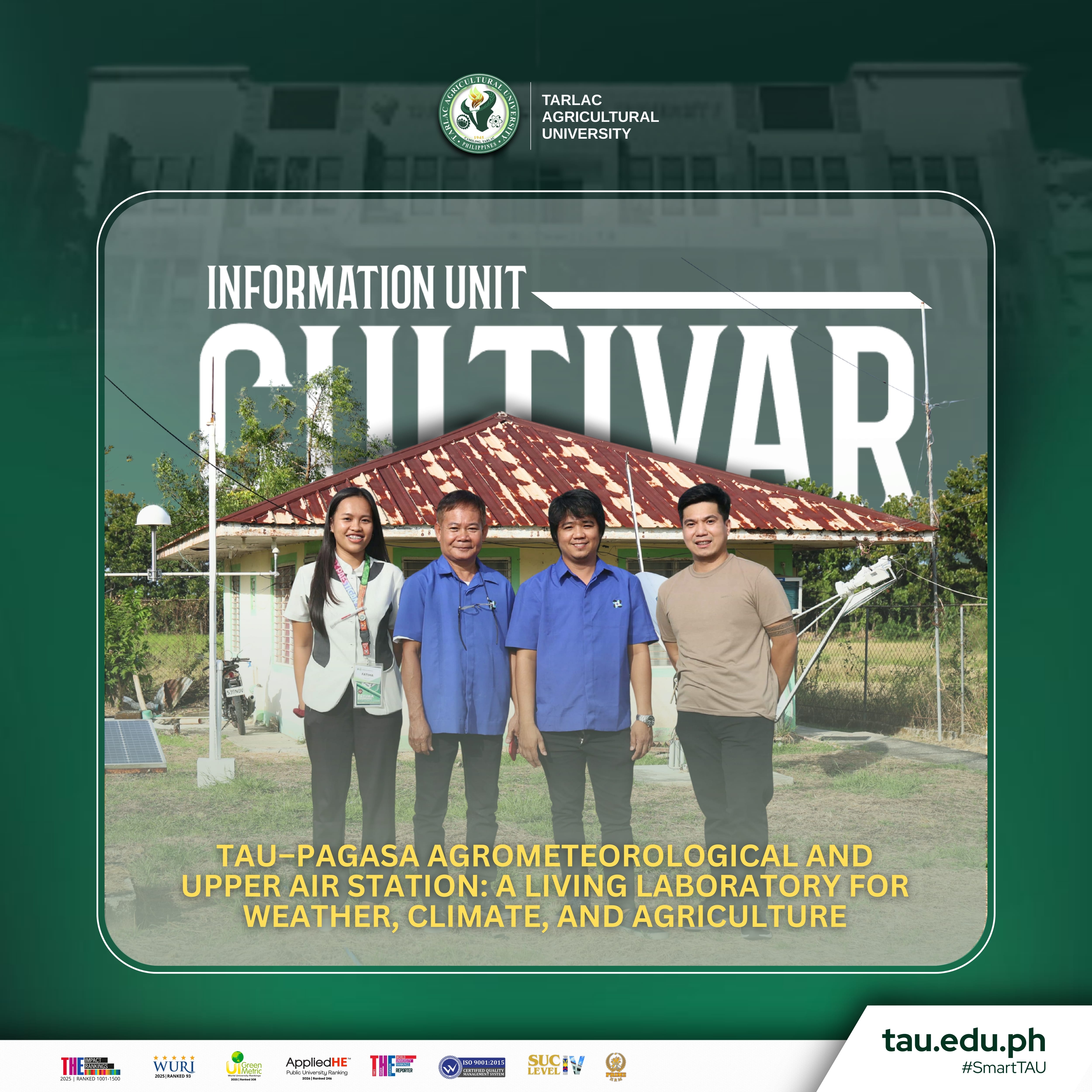
𝐂𝐔𝐋𝐓𝐈𝐕𝐀𝐑 | 𝐓𝐀𝐔–𝐏𝐀𝐆𝐀𝐒𝐀 𝐀𝐠𝐫𝐨𝐦𝐞𝐭𝐞𝐨𝐫𝐨𝐥𝐨𝐠𝐢𝐜𝐚𝐥 𝐚𝐧𝐝 𝐔𝐩𝐩𝐞𝐫 𝐀𝐢𝐫 𝐒𝐭𝐚𝐭𝐢𝐨𝐧: 𝐀 𝐋𝐢𝐯𝐢𝐧𝐠 𝐋𝐚𝐛𝐨𝐫𝐚𝐭𝐨𝐫𝐲 𝐟𝐨𝐫 𝐖𝐞𝐚𝐭𝐡𝐞𝐫, 𝐂𝐥𝐢𝐦𝐚𝐭𝐞, 𝐚𝐧𝐝 𝐀𝐠𝐫𝐢𝐜𝐮𝐥𝐭𝐮𝐫𝐞 (𝙏𝙝𝙞𝙧𝙙 𝙤𝙛 𝙏𝙝𝙧𝙚𝙚 𝙋𝙖𝙧𝙩𝙨)
You may also read Part 1 [https://bit.ly/4qSdJZx] and Part 2 [https://bit.ly/4bFi1iy].
𝐆𝐮𝐚𝐫𝐝𝐢𝐧𝐠 𝐀𝐛𝐨𝐯𝐞 𝐚𝐧𝐝 𝐒𝐨, 𝐁𝐞𝐥𝐨𝐰
For the staff of the TAU–PAGASA Agromet Station, their work transcends ordinary employment; it is a vocation grounded in public service and scientific responsibility. Each day demands constant vigilance and a firm commitment to the farmers whose livelihoods rise and fall with the condition of the atmosphere.
This team does not simply observe the weather; they analyze and interpret it, converting complex atmospheric measurements into practical guidance for the fields that sustain the nation. Their mission responds to necessity. Tarlac’s climate, marked by a pronounced dry season followed by periods of intense rainfall, requires precise, localized information. In such situations, agrometeorological data is not optional; it is often the difference between a successful harvest and severe loss.
“We challenge our farmers to move beyond traditional knowledge alone and integrate scientific data into their decisions,” explains Mr. Eddie V. Ynocando, a 56-year-old agrometeorological observer with 18 years of service. The importance of his work, which began at the Tagaytay Agromet Station, becomes especially evident during isolated thunderstorms and in monitoring the vast, evolving systems of tropical cyclones that threaten agricultural communities.
The station’s mission is sustained by a diverse group of professionals, each confronting distinct demands. For Jonas Joshua F. Tomas, the greatest challenges lie in collecting accurate data during severe weather and reporting for duty even on holidays. These conditions are non-negotiable. He finds meaning in this responsibility, noting that even when Tarlac is placed under Signal No. 4, the team must report for duty because national forecasters rely on their real-time agrometeorological inputs.
Adding further depth to the station’s expertise is Larry Andrew D. Urriza, whose path to meteorology passed through cargo ship engine rooms and overseas work as a technician. Now serving as a Weather Facilities Technician and Observer, he faces both technical and environmental challenges. One unforgettable moment he recalls was encountering a snake during an outdoor parameter check. This captures the unpredictable realities of field-based work.
The team, meanwhile, manages an unrelenting observation schedule: conducting upper-air balloon launches before dawn, monitoring conditions hourly during typhoons, and tracking dangerous heat index levels during the peak dry months.
The station is further strengthened by collaborators such as Engr. Fatima P. Gumamac of the TAU College of Engineering and Technology (CET). As a meticulous faculty member with training from Visayas State University (VSU), she brings agricultural engineering expertise to the station, reflecting the collaborative and interdisciplinary nature of the TAU–PAGASA partnership.
Amid the intensity of continuous monitoring, moments of quiet fulfillment endure. For Mr. Ynocando, every day carries significance. “All day is memorable,” he says. Such is a simple yet powerful reflection of a career defined by purpose. These personal accounts reveal the warm human spirit that operates within a system of rigorous science, often behind cold metal instruments and stoic glasses.
Thus, the modest and often misidentified structure standing alone inside TAU is far more than a “storage room” for sacks of rice. It is a center of foresight. Through disciplined daily measurements and dramatic balloon launches into either tranquil or turbulent skies, the TAU–PAGASA Agromet Station does more than support the forecast of the weather; it protects the future of food security.
Ultimately, it reminds us that the guardians of our collective future are not found only in seats of power or front lines. They are also here, in sun-scorched or rain-soaked fields, carefully decoding the messages of the wind and sky, ensuring that the soil below continues to sustain life, season after season.
#SmartTAU #GreenandGlobal #AgroMet #PAGASA #DOST #SDG4 #SDG13 #SDG17
Text | Jerome L. Duque [Information Unit]
Photos | June Adel S. Guerrero [Information Unit]
Graphics | Omar U. Barauntong [Information Unit]